
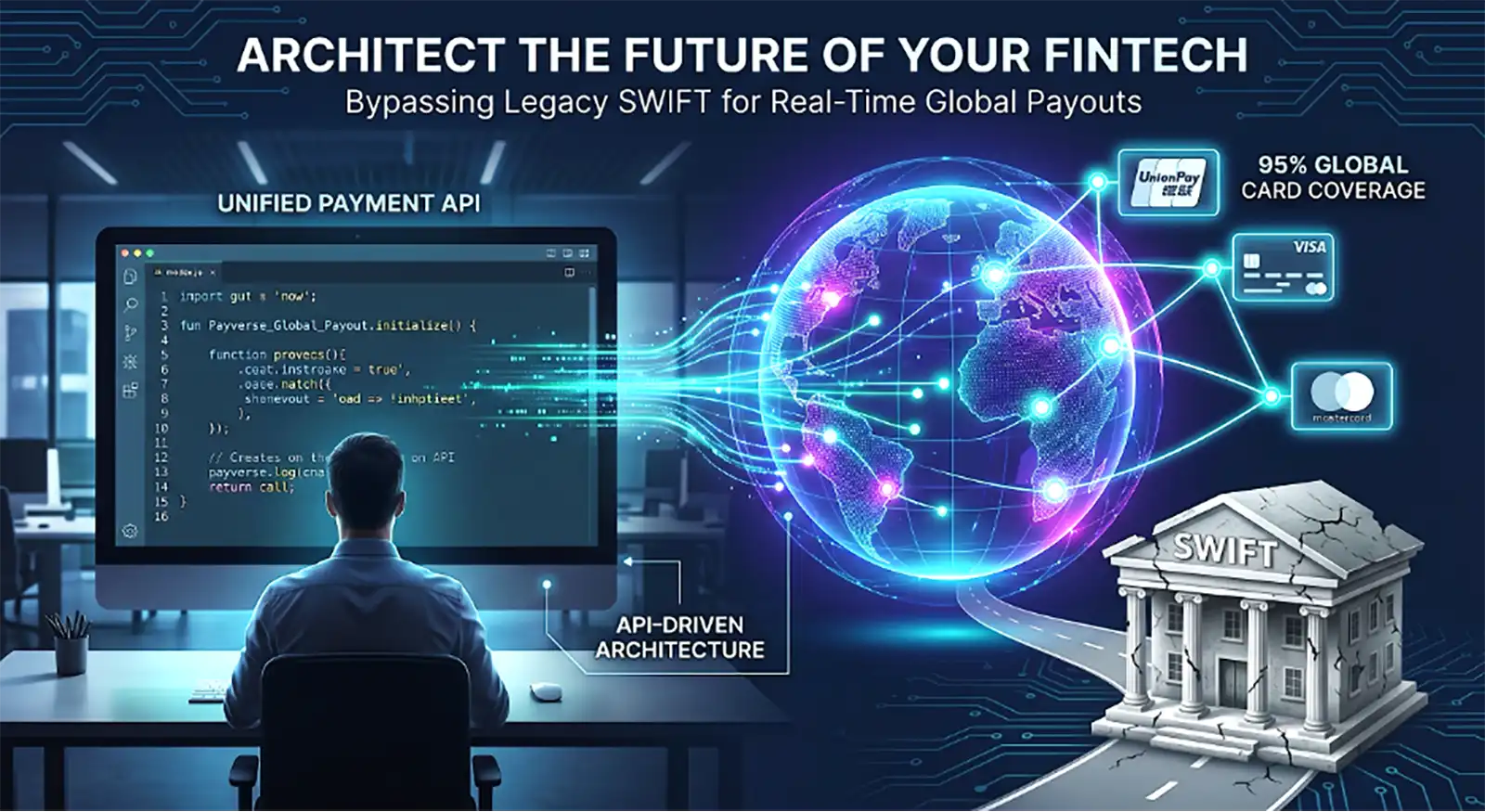
TL;DR Summary: Legacy cross-border remittance infrastructure—heavily reliant on SWIFT and correspondent banking networks—is too slow, opaque, and expensive for modern FinTechs and Payment Gateways. In 2026, the industry is transitioning to real-time, direct-to-card payout networks. By integrating a single API through Payverse, system architects can bypass outdated bottlenecks, pushing funds instantly to 95% of the world’s credit and debit cards via networks like Visa Direct and UnionPay Money Express, all securely backed by U.S. Bank Sponsorship.
For decades, the backbone of global money movement was a patchwork of correspondent banks and legacy wire services like SWIFT. While this infrastructure was revolutionary in the 20th century, modern FinTech founders, Payment Gateway executives, and Money Transfer Operators (MTOs) are finding it fundamentally incompatible with the demands of 2026.
Today’s global digital economy demands instant gratification, low fees, and absolute transparency. System architects are now tasked with a critical mandate: replace outdated batch-and-wire systems with agile, real-time remittance rails.
To achieve this, the industry is pivoting toward direct-to-card payout networks. By upgrading your cross-border remittance infrastructure, your FinTech can push funds instantly across borders, drastically reducing settlement times and unlocking entirely new revenue streams.
The Problem with Legacy Wire Infrastructure
Building a cross-border payment product on legacy rails introduces severe operational and user experience (UX) bottlenecks:
- The Correspondent Banking Chain: Traditional international wire transfers do not move directly from Bank A to Bank B. They bounce through a series of intermediary “correspondent” banks. Each hop introduces processing delays, foreign exchange (FX) markups, and unpredictable fee deductions.
- Lack of Transparency: Because of the multi-hop nature of wire transfers, tracing a delayed or failed payment is a manual, labor-intensive nightmare for your customer support team.
- Settlement Delays: Standard cross-border wires can take anywhere from three to five business days to settle, frustrating end-users who need immediate access to their capital or payroll.
The New Standard: Real-Time Card Payouts
The modern architectural solution bypasses correspondent banks entirely by utilizing the infrastructure that already sits in billions of consumers’ wallets: credit and debit card networks.
Instead of navigating routing numbers and SWIFT codes, direct-to-card technology allows FinTechs and MTOs to “push” funds directly to a recipient’s 16-digit Primary Account Number (PAN).
- Global Reach: Through platforms like Visa Direct and UnionPay MoneyExpress, modern infrastructure connects to the exact networks consumers use daily.
- Near-Instant Settlement: Card networks are engineered for real-time authorization. Funds pushed to a card account are often available to the recipient in minutes, rather than days.
Overcoming the Integration Bottleneck with Payverse
The challenge for system architects has historically been the fragmented nature of these card networks. Integrating individually with Visa, Mastercard, and UnionPay requires years of development, massive compliance overhead, and continuous API maintenance.
This is where Payverse fundamentally shifts the architectural landscape. Instead of building and maintaining a dozen separate integrations, FinTechs and Gateways connect to the Payverse platform via a single, elegant API.
Through this unified connection, your platform immediately gains the ability to push funds to 95% of the world’s credit and debit cards. This includes seamless access to UnionPay MoneyExpress, unlocking real-time payouts to the booming Asia-Pacific region without the need for localized banking licenses.
The Compliance Shield: U.S. Bank Sponsorship
Cross-border money movement is one of the most heavily scrutinized activities by global financial regulators. For emerging FinTechs and Gateways, taking on the direct liability of Anti-Money Laundering (AML) and Know Your Customer (KYC) screening across multiple jurisdictions is a massive barrier to entry.
A robust cross-border remittance infrastructure must handle the movement of money and the movement of risk. Payverse operates with U.S. Bank Sponsorship, meaning your infrastructure is backed by the highest levels of U.S. regulatory oversight and institutional stability. This provides your enterprise with an impenetrable compliance shield, allowing your development team to focus on building great products rather than navigating international financial law.
Architect the Future of Your FinTech
Stop relying on the payment rails of the past. It is time to equip your platform with the speed, transparency, and global reach your user’s demand.
Contact Payverse’s Integration Team Today — Discover how a single API connection can upgrade your cross-border remittance infrastructure and instantly connect you to 95% of the world’s cards.