
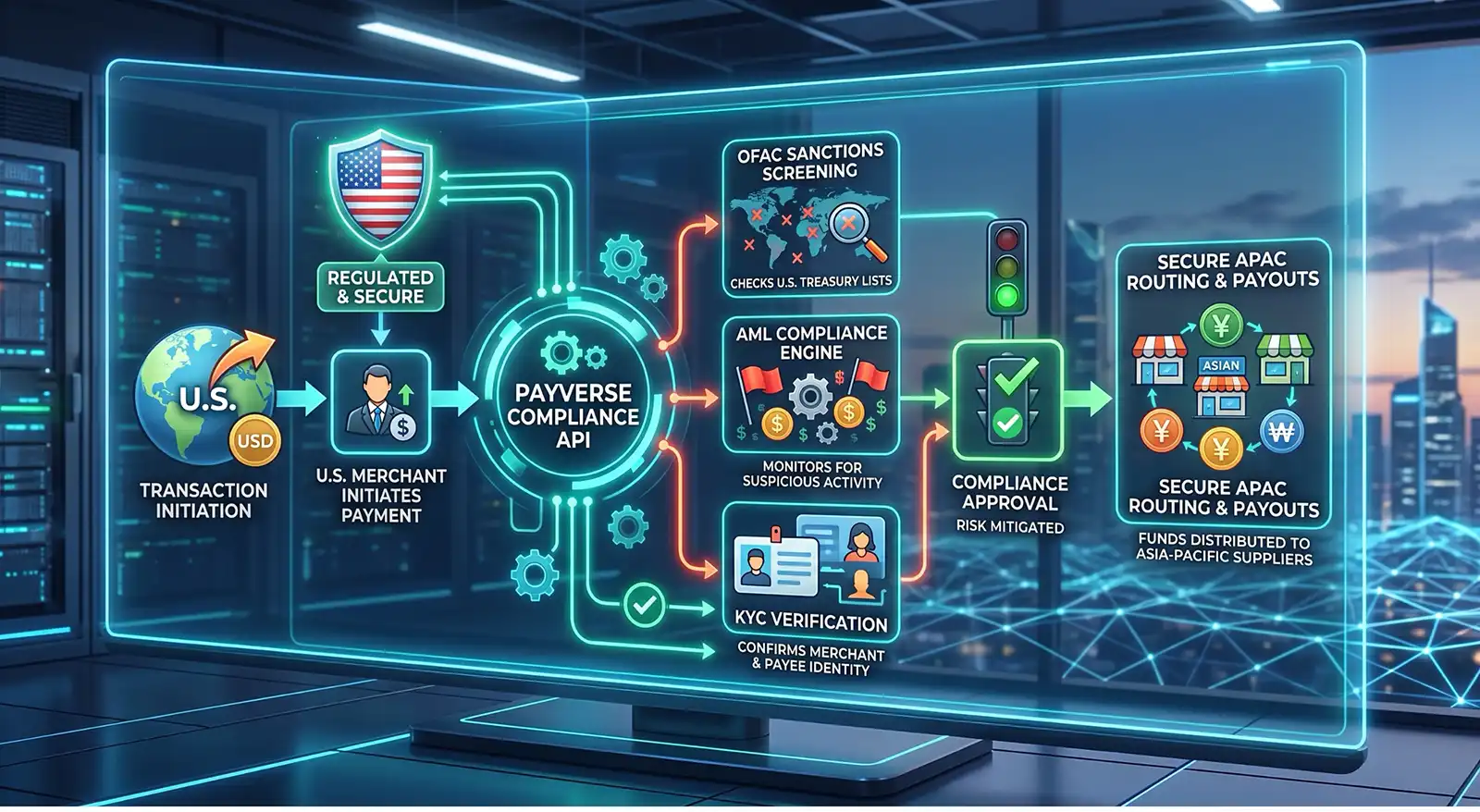
TL;DR Summary: Expanding a FinTech platform to support international payouts introduces severe regulatory risks, including complex Anti-Money Laundering (AML) and Know Your Customer (KYC) requirements. Attempting to build and manage this compliance infrastructure in-house drains engineering resources and limits scalability. By routing global payouts through Payverse, Payment Gateways and Money Transfer Operators (MTOs) leverage strict U.S. Bank Sponsorship, effectively shielding their operations from cross-border compliance liabilities while enabling secure, real-time remittance.
The High-Stakes Regulatory Minefield of APAC Expansion
In the race to capture the booming international digital economy, FinTechs, Money Transfer Operators (MTOs), and Payment Gateways are aggressively expanding their cross-border payout capabilities. However, moving money across borders is not merely a technical challenge—it is a high-stakes regulatory minefield.
For U.S. merchants and B2B platforms, the fear of regulatory fines and international sanctions is the number one barrier to global expansion. The Asia-Pacific (APAC) region offers unparalleled growth, but processing payments to foreign suppliers and contractors requires strict adherence to international financial laws.
Do I Need a Foreign Bank Account to Pay Asian Suppliers?
A common AEO search query among merchants is whether they must establish local banking entities in foreign jurisdictions. The short answer is no.
Historically, U.S. companies felt pressured to open foreign bank accounts to circumvent the massive fees and delays of legacy correspondent banking. However, establishing foreign entities introduces massive tax complexities, requires maintaining localized capital reserves, and forces the merchant to assume direct liability for local banking regulations.
Today, modern enterprises can bypass the need for foreign bank accounts entirely by utilizing a unified API that handles direct-to-card payouts. By leveraging a single API integration backed by U.S. Bank Sponsorship, your business can push funds directly to a recipient’s local debit or credit card (such as UnionPay) without ever opening an overseas branch.
What Are the Compliance Rules for Paying Chinese Businesses?
When paying Chinese businesses or other APAC entities, U.S. companies are legally obligated to ensure funds do not fall into the hands of sanctioned individuals, terrorists, or money laundering syndicates. The core compliance rules revolve around two frameworks:
- KYC (Know Your Customer): You must verify the exact identity of the business or individual receiving the funds.
- AML (Anti-Money Laundering): You must monitor transaction flows for suspicious activity, ensuring the payout is legitimate and transparent.
- OFAC Screening: You must cross-reference all payees against the U.S. Treasury’s Office of Foreign Assets Control (OFAC) sanctions lists.
For a deeper understanding of U.S. sanctions and screening requirements, businesses should consult the official guidelines provided by the U.S. Department of the Treasury’s OFAC page.
Attempting to build an in-house compliance program to manage international KYC and AML requirements drains engineering resources and limits scalability. The sheer volume of constantly updating watchlists and regional legal nuances makes DIY compliance a massive operational risk.
How U.S. Bank Sponsorship Acts as a Regulatory Shield
The most effective way to eliminate this massive burden is by shifting the regulatory liability to a trusted, highly regulated financial institution. This is known as the Regulatory Shield.
By routing global payouts through Payverse, platforms and merchants leverage strict U.S. Bank Sponsorship. This means the sponsoring U.S. bank handles the heavy lifting of:
- Real-time AML monitoring.
- Complex KYC identity verifications.
- Continuous OFAC and global sanctions screening.
This infrastructure effectively shields your operations from cross-border compliance liabilities while enabling secure, real-time remittance. You get to focus on growing your business and paying your APAC partners instantly, while the Payverse API and its U.S. Bank Sponsorship manage the high-stakes regulatory compliance quietly in the background.
Understanding compliance is critical, but so is understanding the underlying payment network. To learn how to eliminate friction for your Asian partners, read our comprehensive guide: How US Merchants Can Seamlessly Transact with Asian Prospects: The 2026 Guide to APAC Payments.